Blog Lobby
Shopify Agentic Storefronts Explained: What DTC Brands Need to Know
–
min. read
March 30, 2026
A few months ago, we published a breakdown of Shopify's Universal Commerce Protocol — what it was, why it mattered, and what it meant for brands trying to stay visible as AI started reshaping the top of the purchase funnel.
Since then, a lot has moved. In late March 2026, Shopify launched Agentic Storefronts, giving merchants a way to sell directly across AI platforms. Right before Shopify’s announcement, OpenAI scaled back instant checkout.
If you've been trying to follow this and feel confused, you're not alone. The headlines have been contradictory, the terminology keeps shifting, and the product reality is still being figured out in real time. Below, we break down exactly what changed with Shopify Agentic Storefronts, what it means for your ecommerce brand, and what to do about it.
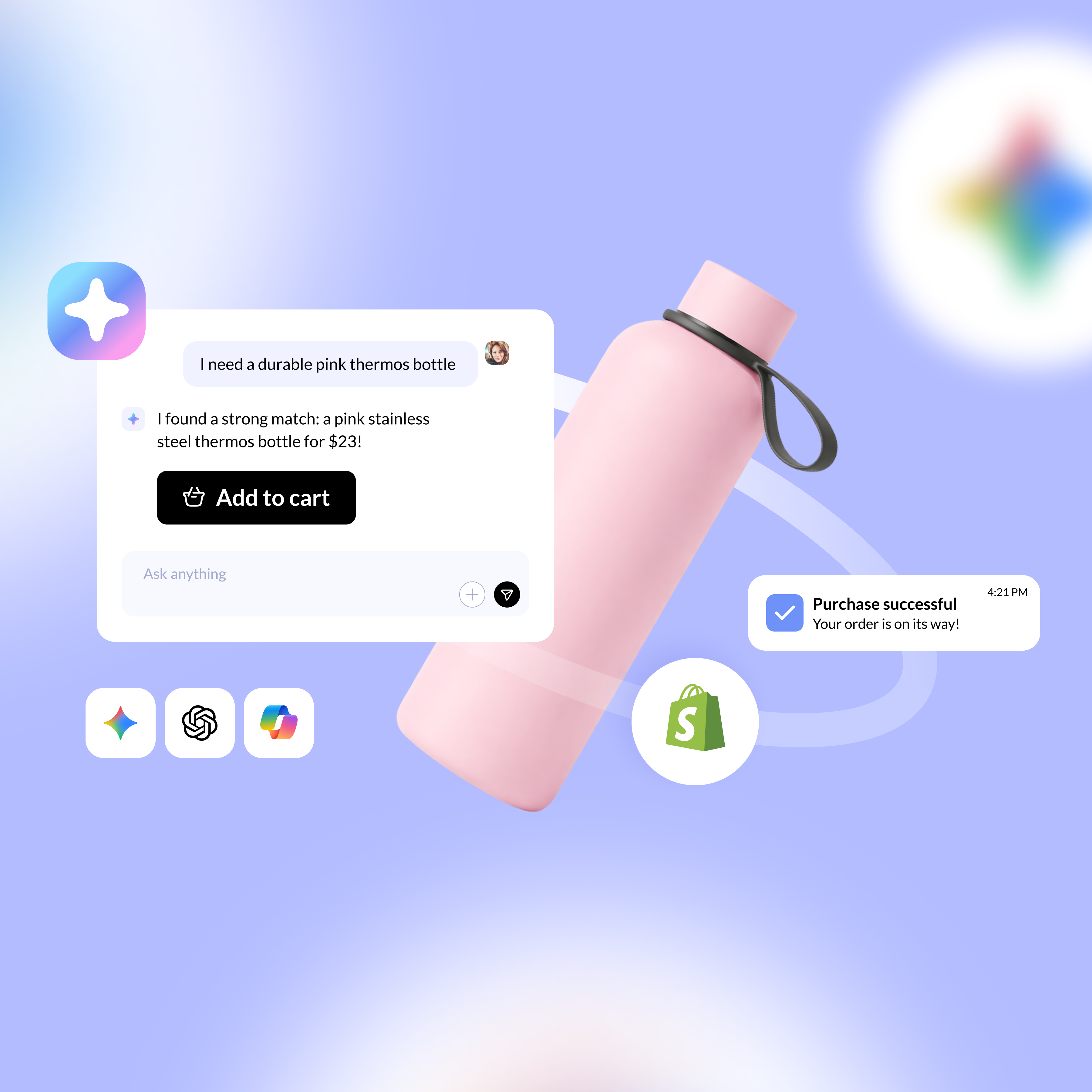
Agentic Storefronts is Shopify's product for getting your store's products discoverable and purchasable across AI platforms including ChatGPT, Google AI Mode, Google Gemini, and Microsoft Copilot, without requiring you to build a separate integration for each one. One setup in your Shopify admin, and Shopify's infrastructure handles syndication across all connected channels.
As of March 24, 2026, this is live for millions of Shopify merchants. Products become discoverable in ChatGPT by default, with no separate integrations and no additional transaction fees beyond standard processing rates. Orders flow into your admin with channel attribution, and you remain the merchant of record, retaining full ownership of customer relationships and data.
It helps to walk through what the experience looks like in practice, because it varies by channel and device, and that variation matters.
A shopper opens ChatGPT and types something like: "I'm looking for navy running shorts, moisture-wicking, under $80." The AI searches across the Shopify Catalog and returns the most relevant options from merchants whose products match. If your product data is in good shape, yours can be among them.
From there, the checkout experience depends on where the shopper is:
On ChatGPT mobile: the shopper completes the purchase through an in-app browser inside ChatGPT. They stay within the ChatGPT experience, but checkout happens on your storefront. Your brand experience, pricing logic, payment methods, and checkout customizations all carry over.
On ChatGPT desktop: ChatGPT links out to your store directly in a separate browser tab.
On Google AI Mode, Gemini, and Microsoft Copilot: the experience is more fully embedded. Shopify's infrastructure supports a checkout flow where customers can fill in shipping and payment details directly in the AI interface and complete the purchase without leaving the conversation at all.
In every case, once the order is confirmed it appears in your Shopify admin attributed to the originating channel, the same as any other sale.
No, and this is one of the most important things to understand about how this works.
Your discoverability in AI channels and your Agentic Storefront settings are completely separate. Turning off Agentic Storefronts only removes the embedded checkout experience. Your products remain discoverable through the Shopify Catalog, through web crawling and indexing, or through any product feeds you have already shared with those platforms for other purposes like advertising.
The practical meaning: even if you opt out of direct selling, you can still appear in AI-powered search results and recommendations. The Agentic Storefront is a checkout layer on top of discovery, not the thing that determines whether AI agents find you at all.
If you want to remove your products from AI channels entirely, discovery included, Shopify does give you that option. But that is a separate setting, and most brands will not want to do that.
This is the engine behind all of it, and it is worth understanding clearly because it determines whether your products show up in AI search in the first place.
The Shopify Catalog is a global catalog of products sold by Shopify merchants. It powers AI discovery and automatically syndicates your product data across AI channels. By default, your product's title, description, options, images, price, availability, and key attributes are structured in a format that AI agents can read and reason about. The Catalog updates continuously, so inventory and pricing stay accurate across every channel.
Think of it as Shopify acting as a translator between your store and AI assistants. When a shopper asks an AI for "waterproof hiking boots under $200," the Catalog is what allows your relevant products to surface with the right details, in the right context. The AI does not have to scrape your website and interpret your product pages on its own. Shopify has already structured that information in a format agents can parse.
For most merchants, the Catalog pulls from your existing product data automatically. But there is also a feature called Catalog Mapping that lets you fine-tune how Shopify interprets your data, especially useful if your store uses metafields, metaobjects, tag prefixes, or custom logic in product titles. If your product data is straightforward, you likely will not need to touch it. If you have built custom data structures over time, it is worth reviewing.
The underlying point: your product data quality is now a direct input into your AI shelf visibility. An AI agent can only recommend your hiking boot for a "waterproof, under $200" query if it can correctly parse that your boot is waterproof and costs $180. Vague descriptions, incomplete attributes, and missing variant details all reduce how reliably AI agents surface your products. This is the new version of SEO, and reviews and user-generated content factor into it too, as AI agents use social proof signals to reason about product fit.
In early March 2026, OpenAI confirmed it was scaling back Instant Checkout, the feature that allowed shoppers to complete transactions entirely within a ChatGPT conversation through OpenAI's own payments infrastructure, with no redirect. A few days later, Shopify announced purchases inside ChatGPT were going live for all merchants. The two headlines seemed to contradict each other. They do not, but the distinction is worth understanding.
OpenAI's Instant Checkout was a fully native transaction living entirely inside ChatGPT, owned and operated by OpenAI end to end. OpenAI pulled it back after finding that users were comfortable browsing and comparing in ChatGPT but tended to prefer completing purchases in a familiar retail environment where they already have accounts and saved payment methods. OpenAI is not retreating from commerce though. It is doubling down on the part it does well, investing heavily in richer, more visual product discovery powered by its Agentic Commerce Protocol.
Shopify's ChatGPT integration is architecturally different. It routes the buyer to your storefront to complete checkout, through an in-app browser on mobile or a new tab on desktop, powered entirely by Shopify's checkout and payments infrastructure, not OpenAI's.
For most brands, OpenAI's retreat is not a meaningful setback. What OpenAI's own data showed is that shoppers are not turned off by a redirect to a trusted storefront. The friction is low enough that the channel still functions as a real sales channel. What matters more is whether your products are visible and surfaced correctly in the conversation. That is what determines whether a transaction happens at all.
No. Agentic Storefronts automatically makes your products available to AI platforms through Shopify's existing data infrastructure. No bespoke integration and no dedicated ChatGPT app required. You toggle individual channels on or off from one place in your admin, and Shopify handles syndication.
Yes. Shopify has opened its Catalog to brands that do not run their storefront on Shopify through a new Agentic Plan, now publicly available globally. You can list your products in the Catalog and get distribution across ChatGPT, Google AI Mode, Gemini, Copilot, and the Shop App without migrating your tech stack.
If you are on a different platform, this is worth evaluating as a distribution layer, not as a reason to re-platform, but as a way to get your products into the AI surfaces where discovery is increasingly happening.
Get your product data in order. This is the highest-leverage action available to you, regardless of which AI channels you are on. Detailed attributes, complete variant information, clear use-case language, and accurate constraints like final sale flags, pre-order windows, and shipping timelines all improve how reliably AI agents surface and recommend your products. The Catalog Mapping feature is worth reviewing if your product data uses any custom structure. Treat this like a site audit for SEO. It pays dividends across every AI channel, not just Shopify's.
Check your admin settings. Agentic Storefronts is live now. Verify which channels are enabled, confirm attribution is flowing into your orders, and start tracking what is converting from AI channels from day one. The early data will matter.
Think about what happens after the sale. Agentic Storefronts handles discovery and the transaction. What comes next, including onboarding, replenishment, cross-sell, and retention, still lives in your lifecycle programs. A customer who buys through ChatGPT after a highly relevant, intent-driven AI conversation should not land in a generic welcome sequence that treats them the same as every other new customer. That is the gap Monocle's AI Journeys is built to close: lifecycle flows that adapt to actual purchase context rather than defaulting to a static sequence regardless of how or why someone bought.
What is playing out across Shopify, OpenAI, Google, and the rest is a genuine infrastructure build, the plumbing for commerce to happen inside AI conversations at scale. The specific mechanics are still being worked out. Checkout experiences differ by channel, consumer behavior across AI surfaces will evolve differently by market and vertical, and new channels will keep emerging.
What is not going to change: AI is becoming a primary discovery surface for shoppers, and it is moving fast. Orders originating from AI searches on Shopify grew 15x between January 2025 and January 2026. The brands investing now in being present and readable in those channels, with clean product data, clear positioning, and retention programs that match the quality of AI-driven acquisition, are the ones that will compound their advantage.
For the full background on the infrastructure layer, Universal Commerce Protocol, the Agentic Plan, and how Shopify's and OpenAI's roles fit together, read our earlier piece: Shopify's Universal Commerce Protocol Explained.
Learn how AI Journeys personalize the lifecycle experience for every customer.