📢 Update: Shopify + OpenAI Commerce Changes (March 2026)
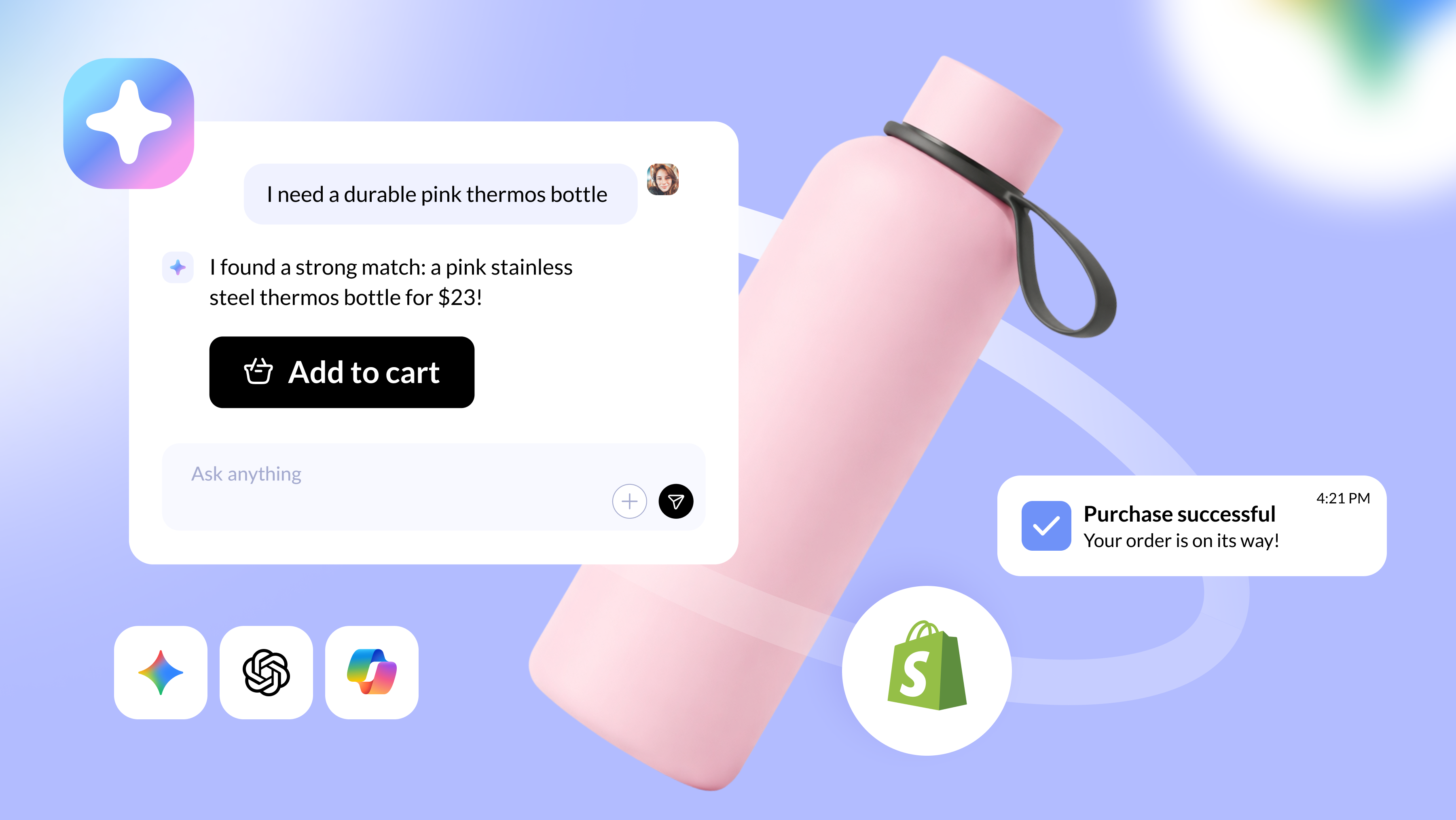
Since this post was published, Shopify has launched Agentic Storefronts, giving merchants a way to sell directly across AI platforms including ChatGPT, Google AI Mode, Gemini, and Microsoft Copilot. OpenAI has also shifted its commerce strategy, stepping back from in-chat instant checkout to focus on richer product discovery. We cover both developments in this new article:
Shopify Agentic Storefronts Explained: What DTC Brands Need to Know →
AI is widely expected to change shopping more than mobile or social did. Or so the prevailing consensus suggests. Recent moves by companies like Shopify, Stripe, OpenAI and Google are laying the groundwork for product discovery and checkout to happen inside AI conversations themselves. Shopify’s new Universal Commerce Protocol (UCP) announcement is one of the clearest signals of where this is going and how brands should respond.
This post breaks down Shopify's UCP in simple terms, how it fits alongside OpenAI’s recent commerce moves, and what it all means for consumer brands from roughly $5 million dollars to $500 million dollars plus in annual revenue.
What Shopify’s Universal Commerce Protocol Announcement Means
Shopify’s UCP announcement is not another AI feature. It is a major move to become the infrastructure layer for commerce inside AI agents across the internet.
Here are the key pieces of the announcement broken down.
1. Universal Commerce Protocol (UCP)
UCP is a new open standard, co-developed by Shopify with Google, that lets AI agents connect to and transact with any merchant. It is designed to make it fast for agents built within Google AI Mode, Gemini, Microsoft Copilot, ChatGPT and others to handle the messy reality of commerce: discounts, loyalty programs, subscriptions, pre orders and edge cases in checkout. It works across multiple technical protocols such as REST, Model Context Protocol, Agent Payments Protocol and Agent2Agent and with any payment processor, including but not limited to Shopify Payments.
2. Agentic Storefronts and embedded checkouts
Shopify is rolling out native, embedded checkout experiences inside:
- Google Search AI Mode
- Google Gemini app
- Microsoft Copilot through Copilot Checkout
- ChatGPT via Shopify’s integration
- A user can chat in one of these AI interfaces, discover a product and check out without ever leaving the conversation while Shopify powers the underlying transaction and merchant connection.
3. Agentic plan and Shopify Catalog, now open to non Shopify brands
Shopify is opening its Shopify Catalog, a normalized, enriched catalog of billions of products, to brands that do not run their online store on Shopify. These brands can join via a new Agentic plan, list their products in the Catalog and sell through AI channels, the Shop app and future partners without migrating their storefront. Shopify’s Catalog uses specialized models to categorize and enrich product data so AI agents can understand products quickly and accurately and surface the right options in seconds.
The result is that Shopify is positioning itself as the backbone that connects any brand to every major AI shopping surface.
How Shopify's UCP Compares To OpenAI's Agentic Commerce Protocol
Over the past few months, OpenAI has also been making strides to transform ChatGPT into the future storefront, where shoppers can not only search and discover products but also checkout within a conversation.
OpenAI’s moves include:
- Turning ChatGPT into a shopping destination where users can:
- Ask for product advice such as “find me a carry on for a 3 to 5 day trip under 350 dollars”
- Receive curated recommendations and comparisons
- Complete checkout inside ChatGPT with instant, agentic flows
- Introducing richer shopping and research tools so people use ChatGPT for “what should I buy” instead of defaulting to search or marketplaces.
- Launching the OpenAI Agentic Commerce Protocol with Stripe
- If a merchant already processes payments with Stripe, they can enable agentic payments in as little as one line of code.
Zoomed out, Shopify and OpenAI are doing different but complementary things.
| Dimension | Shopify | OpenAI |
|---|
| Primary Role | Infrastructure and distribution. The backbone that lets many AI agents talk to many merchants and complete transactions. | Destination and interface. A high intent shopping surface where users ask, refine, compare and buy in one place. |
| Focus User | Merchants and brands, including non Shopify, that need to appear and transact across AI channels. | Consumers who want to research and buy in a natural language interface, plus brands that integrate into ChatGPT flows. |
| Control Surface | Embedded checkouts and flows inside Google AI Mode, Gemini, Copilot, ChatGPT and others. Shopify powers the commerce but does not own the full UX. | Fully controlled UX within ChatGPT. The agent orchestrates research and checkout end to end. |
| Data Strength | Deeply commerce native. Products, pricing, variants, transactions and operational flows across millions of merchants | Deeply intent native. Conversational context and cross domain understanding of what the user is trying to accomplish. |
| Long Term Bet | Every AI agent will need a flexible, neutral commerce protocol and a clean, shared catalog. | A large share of shopping journeys will start and finish inside conversational AI like ChatGPT. |
For brands, the practical takeaway is that Shopify is making it easier to get products into many AI agents while OpenAI's moves focus on integrating shopping agents within ChatGPT.
What Shopify's UCP Means for Consumer Brands
The core shift is from “search, click, land on a site” to “ask, converse, buy.”
The old pattern:
- A customer searches on Google.
- Clicks a product listing or ad.
- Lands on a product page and maybe buys.
The emerging pattern:
- A customer asks an AI something like “I need a weekender bag that fits overhead, looks minimal and is under 250 dollars.”
- The AI:
- Clarifies preferences such as size, materials and brand values.
- Narrows down options, often across multiple brands.
- The customer buys inside the conversation through an embedded checkout.
The implications:
- The primary discovery surface may not be a website or even classic search. It is AI agents that act as meta retailers.
- The competitive set is defined dynamically per query. Brands appear side by side based on fit to intent rather than purely on ad spend.
- Product and brand stories must be understandable to machines. If an agent cannot read and reason about differentiation, it cannot advocate for that brand in the conversation.
Three new battlegrounds emerge for brands.
- AI shelf visibility
Can AI agents reliably discover and surface products for relevant queries across channels like ChatGPT, Google AI Mode, Gemini and Copilot. - Agent reasoning about your brand
Can AI explain why a product is a better fit for a given customer using information provided in product data, content and reviews. - Post purchase lifecycle through agents
As AI becomes the default interface for “where is my order”, “what should I buy next” and similar questions, those interactions can either deepen relationships or be owned entirely by third party agents.
The Agentic Commerce Playbook for $5M-$50M Brands vs $100M+ Enterprise Retailers
For $5M-$50M Brands: Learn to Leverage the Rails
If you are a growing brand, you usually won’t have the resources to build your own AI ecosystems but can compete in this environment if you move early.
Treat Shopify and similar systems as AI distribution operating systems
- If on Shopify:
- Adopt agentic features as they roll out and ensure products are in Shopify Catalog with clean, enriched data.
- Turn on and prioritize channels like Google AI Mode, Gemini, Copilot Checkout and ChatGPT integrations as they become available.
- If not on Shopify:
- Evaluate the Agentic plan as a distribution layer. Even if the main storefront is elsewhere, getting into Shopify Catalog can provide reach into multiple AI surfaces.
Obsess over product data and schemas
Product data quality is a key equalizer for growing brands.
- Make the catalog AI readable:
- Use structured attributes for size, fit, materials, use cases, care, compatible products and similar details.
- Capture clear constraints such as pre order windows, final sale flags, shipping windows and inventory rules.
- Articulate benefits and positioning: who the product is for, what problem it solves, when it is better than alternatives.
- Invest in reviews and user generated content that express use cases and outcomes because these signals influence AI recommendations.
Design conversational journeys, not just landing pages
- On owned properties:
- Implement a strong AI assistant that can diagnose intent, guide to the right products, handle objections and tie into retention.
- For off site agents:
- Provide FAQs and structured content that answer likely questions about sustainability, use cases, comparisons between models and similar topics.
Use agentic channels as a retention amplifier
Even when checkout happens inside Google AI Mode or ChatGPT, the relationship can continue.
- Capture first party data so that order information and consent from agentic channels synchronizes into lifecycle systems such as email and SMS tools.
- Trigger lifecycle journeys based on agentic purchases, such as onboarding and education flows, replenishment timing and post purchase surveys aligned to the original intent.
For $100M+ brands: Build a Layer on Top of the Rails
Go beyond generic integrations to co-designed agent experiences
- Partner directly with AI platforms to:
- Co-design official brand agents or experiences inside ChatGPT, Google or Copilot.
- Negotiate richer placements such as interactive guides or bundle builders.
Treat product data and ontology as strategic assets
- Build and maintain a robust internal product ontology with unified attributes and definitions across regions.
- Create brand specific reasoning layers through fine tuning or instruction that encode brand guidelines, sustainability frameworks and sizing logic.
Integrate agentic commerce into the full customer experience stack
- Unify order and identity so that purchases via site, ChatGPT or Google AI Mode map to a single customer profile in CRM and lifecycle systems.
- Bring agents into post purchase and loyalty so branded assistants can handle returns, warranties and recommendations in line with internal data.
Experiment with agent to agent and B2B flows
- In wholesale and B2B:
- Enable agents representing retailers to talk to inventory and pricing agents via protocols such as UCP.
- Automate replenishment and merchandising suggestions agent to agent to reduce friction
Agentic Commerce: Reality vs Hype
Over the next few years, AI shopping is likely to start as a parallel channel rather than an overnight replacement for web and search, but its share of discovery and conversion should grow steadily. Brands should see this as a gradual but compounding channel shift.
The brands that win will:
- Treat AI agents like a new class of retailers and search engines combined, with real shelf space and merchandising dynamics.
- Invest early in structured product data, catalog integrations and conversational experiences that make it easy for agents to understand, recommend and transact their products.
- Build measurement and operations around agentic channels, tracking AI driven discovery and checkout flows alongside traditional traffic and attribution instead of hiding them inside generic referral buckets.
Where Monocle's AI Journeys Fit In
As acquisition moves into AI agent territory and becomes more intent rich and dynamic, retention and lifecycle become the main levers that brands truly control. Customers will experience highly relevant, adaptive journeys during acquisition, so retention has to match that level of personalization.
Monocle’s role in this world is to help brands:
- Match AI level relevance in retention
When a customer’s first touchpoint is a conversational AI experience that feels tailored to their needs, generic batch campaigns will feel disconnected. Monocle enables lifecycle marketing programs that are driven by data, adapted per customer and aligned with the same kind of granular signals that AI agents use during acquisition. - Turn AI driven first purchases into long term relationships
If a customer buys through an AI surface, the brand owns less of that initial experience. Monocle helps close the gap by using purchase and behavioral data to infer intent and use cases, then orchestrating onboarding, education and cross sell journeys that feel like a continuation of that relevant experience rather than a cold restart. - Continuously adapt journeys to each individual
Instead of rigid, pre-baked sequences, Monocle focuses on lifecycle flows that respond to what each customer actually does over time: what they bought, how they use it, how often they return and what signals they send across channels. That makes lifecycle and retention feel as responsive as an AI agent, and not as static as a traditional funnel.
In an era where AI agents increasingly own the front of the funnel, the brands that thrive will be the ones that use tools like Monocle to make the rest of the journey just as intelligent, relevant and personal as the first AI mediated interaction.