Blog Lobby
How to Future-Proof Retention for the Agentic Commerce Era
–
min. read
January 5, 2026

The way customers discover and buy products is changing fast and becoming far less predictable.
AI shopping assistants like ChatGPT, Claude, and Perplexity are becoming the new starting point for product research. Customers can ask open-ended questions and get personalized, curated recommendations in seconds, complete with comparisons, reviews, and alternatives tailored to their specific needs.
The AI uses its own logic to surface options. It doesn't prioritize based on ad spend, SEO rankings, or brand awareness. It optimizes for the customer's stated criteria, whether that's ingredients, price, sustainability, or performance.
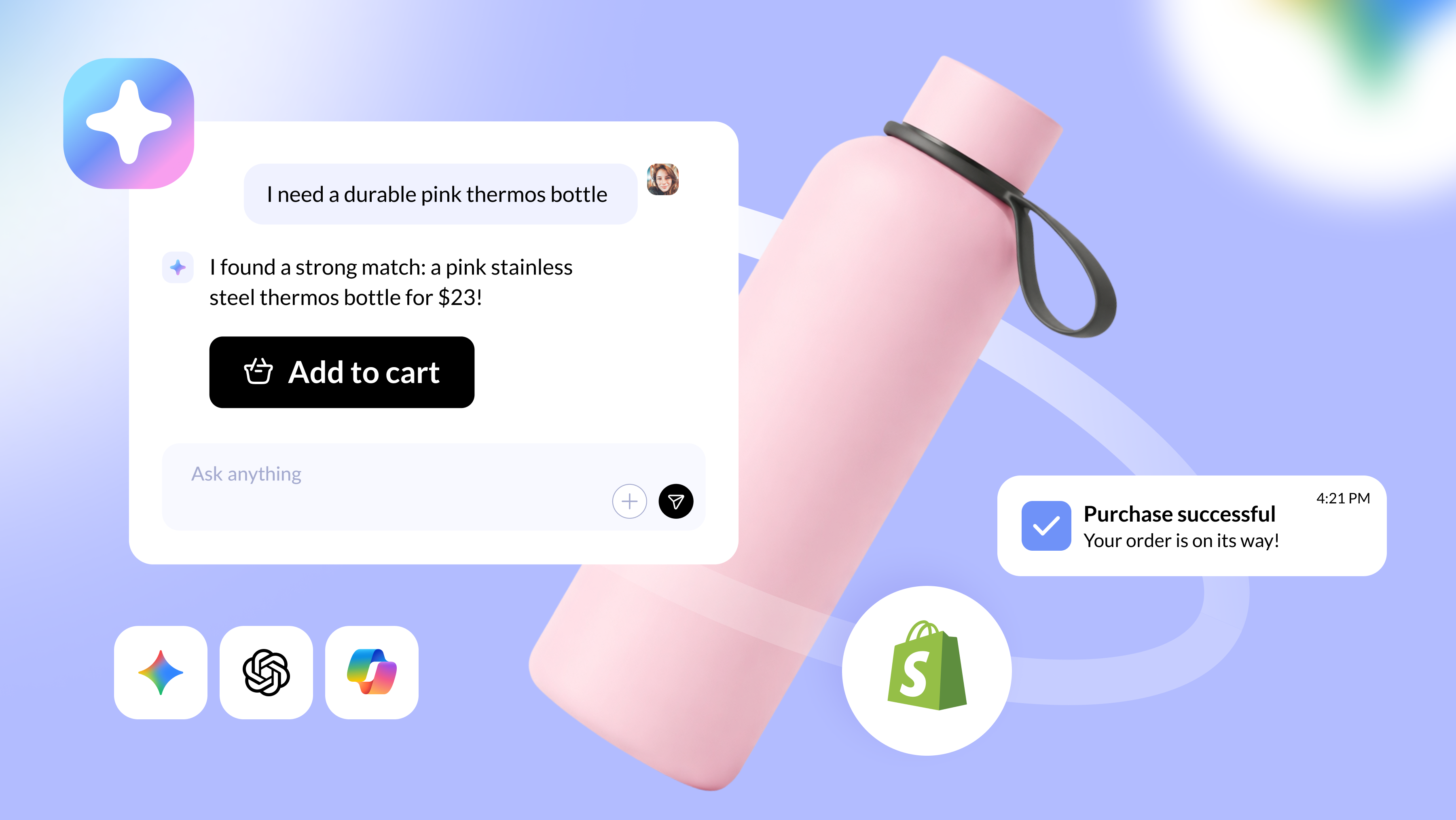
And increasingly, the entire journey from discovery to purchase can happen without customers ever visiting your site. This is what's being called zero-click commerce: customers complete their first purchase with your brand inside an AI platform you don't control.
Perplexity's recent integration with PayPal and Shopify, along with ChatGPT's instant checkout capabilities, means this isn't a future trend. It's already happening.
The numbers reflect how quickly this is accelerating:
For D2C brands, this creates both a challenge and an opportunity.
Discovery is becoming more unpredictable. Customers may never browse your site, engage with your content, or follow traditional acquisition paths before making their first purchase. The context you once had about how customers found you and what they experienced before buying is changing.
At the same time, average customer acquisition costs for ecommerce brands now often sit in the 60–80 dollar range, with many consumer categories paying well over 100 dollars per new customer, according to Shopify ecommerce benchmarks. The window between first purchase and second purchase, when customers decide whether to become repeat buyers or ask an AI to find them alternatives, has never been more critical.
Yet while discovery is being reimagined through zero-click commerce, retention strategies haven't kept pace. Most brands are still using the same playbook they relied on a decade ago: segmentation, static flows, manual rules.
There's a real opportunity for retention to catch up, match the intelligence customers are experiencing in discovery, and become a much stronger lever for growth.
Agentic commerce refers to the use of AI as a personal shopping assistant that understands a customer's needs, searches and compares products from multiple sources, and helps complete purchases based on that customer's unique preferences and requirements.
Unlike traditional search or product recommendation systems, agentic commerce involves AI that actively participates in the shopping process. It interprets customer intent, asks follow-up questions to refine understanding, evaluates product options using contextual reasoning, filters choices according to stated preferences, and can even complete transactions directly within the conversation.
Major platforms have already made this shift operational:
ChatGPT's shopping research feature asks smart clarifying questions, researches deeply across the internet, reviews quality sources, and builds on its understanding of you from past conversations and ChatGPT memory to deliver a personalized buyer's guide in minutes. It now includes instant checkout capabilities.
Perplexity has made its shopping feature free for all U.S. users and integrated with PayPal, Shopify, and BigCommerce, allowing users to discover and complete purchases without leaving the platform.
Claude, Gemini, and other AI assistants offer similar research capabilities, helping users narrow down options based on preferences, budget, and specific needs.
Amazon is integrating AI shopping assistants that understand context from browsing history, past purchases, and stated preferences.
According to Klaviyo's Global AI Shopping Index, 65% of consumers expect AI to be a normal part of the online shopping experience by 2026.
The key difference is that discovery shifts from being shaped mainly by brands to being guided by AI agents that prioritize each shopper's needs and preferences.
The rise of agentic commerce creates two major shifts for D2C brands:
When customers can ask an AI assistant for "alternatives with better ingredients" or "a more affordable version of this product" and get instant, personalized recommendations, trying other brands becomes almost effortless.
The AI optimizes for the customer's stated preferences, not brand equity or ad spend. This means:
As a result, that second purchase becomes an even more critical retention checkpoint.
Once customers experience AI that remembers their preferences, asks smart clarifying questions, adapts to their behavior, and delivers truly personalized guidance, they notice when other experiences fall short.
Generic "We miss you!" emails, broad discount blasts, or poorly timed follow-ups feel unsophisticated next to hyper-personalized, AI-powered discovery. In a world where finding alternatives is simple, any experience that feels irrelevant or dull makes disengagement, and switching, more likely.
Winning that second purchase and growing customer lifetime value now depends on exceptionally strong customer experiences and far more intentional, intelligent Email/SMS programs. Brands that deliver adaptive, context-aware retention journeys that feel as smart as AI-powered discovery will earn stronger relationships and better retention economics.
When customers discover your brand through ChatGPT or Perplexity, they are typically high-intent, because the AI has already helped them research, compare options, and narrow down to a short list. More often, they arrive ready to buy rather than casually browse.
That first purchase can increasingly happen in an environment you don't fully control:
So what happens next? How do you turn that AI-driven discovery moment into a relationship you own?
Traditional retention strategies often assume customers arrived through known channels, engaged with your content, and followed a familiar journey. But customers who discover you through AI assistants may skip most of those steps.
If your retention strategy treats them like every other first-time buyer, you're missing important context about how they found you and what they need next to become repeat customers.
Platforms like Shopify and PayPal are already passing referral data that allows marketers to identify LLM-origin traffic. This creates an opportunity to segment these shoppers and personalize their experience based on how they discovered your brand.
The brands that figure out how to bridge AI discovery to owned channel engagement, and deliver retention experiences that match the intelligence of that first interaction, will build stronger customer relationships.
Three major shifts are changing what effective retention looks like:
Traditional triggers only capture obvious signals: cart abandonment, purchases, signups, and unsubscribes.
But meaningful intent often shows up in subtler patterns. Someone browsing your site three times in two days without adding to cart. Consistently opening emails but rarely clicking. Making a single purchase months ago and suddenly returning to research the category again.
These behaviors signal interest, hesitation, or reconsideration, but they require more sophisticated detection than static rules can provide. The gap between what customers are signaling and what most retention systems can detect represents significant missed opportunity.
Different customers need entirely different next steps. Some need immediate follow-up. Others need educational content delivered over weeks. Some need space before the next touch. Others respond best to a single, well-timed nudge.
Traditional flows can technically handle this variety, but the complexity quickly becomes unmanageable. Every edge case requires new branches, new rules, and constant maintenance. As customer paths become more varied and unpredictable, there's a growing need for systems that can dynamically decide timing, channel, and content rather than relying on manually coded logic trees.
In the past, a generic or mistimed message might get ignored, but customers would likely stick around.
Now, when customers can ask an AI assistant to find alternatives in seconds, every irrelevant or poorly timed touchpoint increases the likelihood they'll start exploring other options.
Retention experiences that feel as intelligent and personalized as AI-powered discovery aren't just an optimization anymore. They're becoming table stakes for building relationships customers want to maintain.
Leading D2C brands are moving from broad segments to individual-level decisioning. This doesn't replace creative or strategy, it changes how and when decisions are made for each customer.
Real personalization is less about producing more subject lines or copy variants and more about making smarter micro-decisions per person:
The same adaptive decision-making customers experience in AI-powered discovery can be applied to retention. Modern systems use behavior and context to automate these choices, making retention feel coherent and responsive rather than rigid and rule-heavy.
Modern retention can tune frequency and timing to real signals.
High-intent customers might receive more frequent touchpoints, while those showing fatigue or lower engagement see fewer messages and more value-focused content. Aligning outreach to observed behavior instead of fixed schedules reduces over-messaging while maintaining or improving conversion rates.
AI shopping assistants help customers find good value, not simply the lowest price. They optimize for fit alongside cost.
Retention can work the same way. Instead of blanket discounts, intent-driven offers account for price sensitivity, likelihood to convert without an incentive, and potential lifetime value.
The goal is to use promotions selectively and contextually so they support both customer satisfaction and margin health, rather than conditioning customers to wait for sales.
Customers who arrive via AI assistants often start differently than those from paid social or search. They've typically done more research, compared more alternatives, and chosen the brand based on specific criteria.
As platforms like Shopify and PayPal surface referral and context data, brands can identify these cohorts and design follow-up journeys that acknowledge how customers discovered them. Instead of dropping AI-referred customers into generic first-time buyer flows, retention can use acquisition context as a valuable signal, making the experience feel like a natural continuation rather than a disconnected restart.
Monocle was built to give retention teams something they haven't had before: an AI layer that can reason per customer, at scale without requiring a platform migration or engineering resources.
Here's what changes:
From manual segmentation → To individual-level reasoning based on first-party data
From fixed flows → To adaptive journeys that adjust per customer
From uniform discounting → To intent-driven offers that protect margin
From channel-agnostic strategies → To acquisition-aware personalization that understands how customers discovered your brand
Monocle's AI agents integrate directly with your existing Shopify + CRM + ESP + SMS stack and:
This is the same kind of adaptive, context-aware intelligence customers are experiencing with ChatGPT, Perplexity, and other AI shopping assistants—but applied to the full customer lifecycle after acquisition.
The goal: create retention experiences intelligent enough to bridge the gap between AI-powered discovery and owned channel relationships.
For customers who discover you through AI assistants, this means follow-up that acknowledges their high-intent journey and continues the personalized, context-aware experience they've come to expect.
For all customers, it means retention that can finally match the sophistication of modern discovery experiences.
Learn how AI Journeys personalize the lifecycle experience for every customer.